
THANK YOU FOR SUBSCRIBING

Pharma Tech Outlook Weekly Brief
Be first to read the latest tech news, Industry Leader's Insights, and CIO interviews of medium and large enterprises exclusively from Pharma Tech Outlook


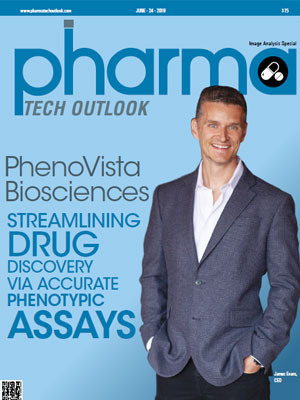
 James Evans, CEO
In any investigation, scientists continually design (and redesign) their experiments to either broaden or focus the scope of their discoveries. In the world of drug discovery research, phenotypic screening fits this context which historically has helped identify the majority of first-in-class drugs. This is possible due to the processes’ unbiased approach while identifying a drugs mechanism of action or impact on cell function. Not being limited by prior knowledge of specific molecular targets, like target-based approaches, phenotypic assays provide a pivotal method in drug discovery. Evidence based on FDA filings suggests that in an era were target-based approaches were more prevalent, the FDA approved 50 first-in-class molecules discovered using a phenotypic approach.
Use of novel technologies in a streamlined manner is a necessity to garner the maximum value that aphenotypic process offers. But such technologies largely remained at the disposal of big pharmaceutical companies or very specialized labs. Founded on the belief that true discovery is only possible with the openness to new and creative ideas and that “everyone deserves a shot at improving people’s health,” PhenoVista Biosciences—started in 2014—levels the playing field providing advanced capabilities to biotech and pharma companies that may not have sufficient in-house specialists. Unlike other CROs, the company exclusively focuses on delivering services pertaining to high content imaging-based phenotypic assay. “We realized that there wasn’t a niche service provider that offered a world-class standard of service and we could make a significant impact in the market with a precisely focused offering,” asserts James G. Evans, CEO of PhenoVista Biosciences.
Evolution of the Market: From Reluctance to Acceptance
In the early years after its inception, PhenoVista’s clients were hesitant toward their offerings in terms of the stem cell models that were being offered. Furthermore, as most companies were inclined towards using a target-based approach back then, it was challenging to show the benefits of a phenotypic approach. When the analysis of drug discovery strategies by the FDA identified the greater number of discoveries through phenotypic screening compared to target-based screening, there was a dramatic surge of interest in the approach that continues to grow today. Using it’s meticulous yet automated approach to imaging-based studies, Phenovista has been able to directly address any concerns from tentative clients by directly supporting data trends using images – after all, an image is worth a thousand words and Phenovista generates millions of images!
Over the last two years, after witnessing the high value of results that Phenovista’simaging-based phenotypic approach has delivered, drug discovery organizations are now pushing to take it to the next level.
Now, the need of the hour is to investigate more complex models including co-cultures, 3D biology and microfluidic platforms, all of which in turn calls for more sophisticated imaging and data analysis solutions.
Every week we deliver data and findings to our clients that literally makes them say “wow!”, it’s the most fulfilling aspect of life at Phenovista
Solutions for Large and Small Businesses Alike
“Delivering a specialized solution would be beneficial only for the small biotech companies as they don’t have the right technology,” this was the thought behind PhenoVista’s conception, and “we could not have been more wrong,” says Evans. The company found out that their offerings were coveted by the “big guns” as well. Often, even large pharmaceutical companies did not have the bandwidth or specialists to handle large-scale projects cost-effectively. Unlike small businesses that have defined goals as well as specific challenges, large companies have more open-ended queries, with a zeal to explore new aspects of biology. This requires a more adaptable environment and a strategy that leverages high-performance image analysis.
Listen.Strategize.Build
An example of an open-ended query is the initiative for cell painting, which is a marker-agnostic approach in labeling cells with a palette of different fluorescent markers. Considering this scenario, PhenoVista would initiate an intensive discussion with their client to understand their prerogative, go through the organization’s literature, and conduct their own research, all with the intent to establish short-term and long-term goals. Then they would put together a detailed and steady plan that would be shared with the customer to gain their insights to further tweak and perfect the project plan. However, one of the many hurdles during this discovery phase is the introduction of new information that may alter the course of the laid out plan. In this instance, the company has the rather unique ability, compared to traditional CROs, to adapt and change the plan accordingly to accommodate the changes.
Exceptional Value Proposition
One of the services PhenoVista provides its clients are assay feasibility studies as well as its development and screening. During the feasibility phase, there are a lot of different assay parameters to be evaluated and validated, so they have several liquid handling platforms that provide different capabilities, all aimed at generating samples in a sterile environment. This is a crucial criterion as every culture may need to be studied over long periods without being contaminated.
Furthermore, during the screening phase, any cultures gathered through approaches such as parallel liquid handling, acoustic or laser-based deposition provide unbiased data, which integrates quite well with their automated confocal microscopes. The plates containing the cultures generated are then fed into one of the several robotic fluorescence microscopes that will scan those plates automatically by focusing or analyzing the images and siphoning the data into a scalable database. The amassed data can then be structured, filtered, and made use of in tune with the clients’ requirements or nature of their study. The company designs all their assays using standardized methods and quality-controlled reagents. This allows them to mix and match components such as cell types, antibodies, and substrates as appropriate.
 Anthony Essex, Chief Scientific Officer
Evans credits the company’s success to the team behind the scenes, who ‘spin straw into gold.’ Every employee working has experience and knowledge around fluorescence microscopy, which is a key differentiator. They have immense knowledge of a cell’s biology, culture, and behavior. Some are experts in neurobiology, others in immuno-oncology. Every staff member brings in their own blend of experience and proficiency that completes the array of solutions PhenoVista offers.
An Instance of Success
The company has just completed an 18-month project with a large pharmaceutical company that was interested in a neuro-inflammation model that showed how microgliamigrate in a 3D context. PhenoVista helped develop a scalable platform which allowed them to look at both directed migration across gradients and phagocytosis of target molecules. Evans humbly states that though the project was quite challenging, it was a great opportunity to learn a lot of aspects of biology. The discoveries led to them developing the assay format to answer the arising questions to be with more quantitatively and greater scalabilty. Now the client has a platform with which they can find the answers they are looking for, to better understand and solve their query with the aid of a scalable screening solution.
Exceptional Growth and a Promising Roadmap
The past year has been an exhilarating ride for the PhenoVista team. They have experienced dramatic four-fold revenue growth and have expanded their team of specialists accordingly. Their hard work and ingenuity to find the right fit solution for clients has helped them gain a strong foothold in the market. Not only have they managed to retain greater than 80 percent of their existing clientele but they are adding multiple new clients every month.
"Our platform allows us to distill down the most relevant information to the client so that they can make an informed decision with the highest degree of certainty"
Continued growth at Phenovista is occurring via selective integration of complementary platforms including 3D biology models and microfluidic systems that improve physiological relevance, and enabling technologies that improve throughput and data quality. Not losing sight of the big picture, Evans states “By helping scientists find better drugs more quickly, Phenovista aims to reduce the cost of drug development, increasing access to medication and therefore improving the lives of everyday people all over the world.”
Company
PhenoVista Biosciences
Management
James Evans, CEO and Anthony Essex, Chief Scientific Officer
Description
Offers high content imaging-based phenotypic assay development and screening services using best-of-breed technology